


PRESS RELEASE
FOR IMMEDIATE RELEASE
Monday, May 18, 2026
MEDIA CONTACTS:
| Tracy Zarrillo, Assistant Agricultural Scientist 1 Department of Entomology The Connecticut Agricultural Experiment Station Phone: 203-974-8473 Email: Tracy.Zarrillo@ct.gov |
Dr. Kelsey E. Fisher, Assistant Agricultural Scientist 2 Department of Entomology The Connecticut Agricultural Experiment Station Phone: 203-974-8561 Email: Kelsey.Fisher@ct.gov |
New Haven, CT – Pollinators are essential to maintaining healthy ecosystems and sustaining food production; however, many species are facing serious declines or remain poorly understood.
Connecticut is home to an impressive diversity of at least 397 wild bee species, each with unique ecological requirements and conservation challenges. Of these, nine species are currently listed as Species of Greatest Conservation Need, while an additional 39 are designated as State Assessment Priority Species.
Surveying and mapping the distribution of these species across the state is critical to understanding their population trends, identifying threats, and guiding targeted science-based conservation strategies.
Among Connecticut’s native bees, the yellow-banded bumble bee (Bombus terricola) is of particular concern. Across its historic range in the northeastern and upper Midwestern United States, this species has declined by nearly 50 percent.
Once widespread across six of Connecticut’s eight counties, Bombus terricola went undetected in the state for nearly a decade, from 2009 until its rediscovery in Litchfield County in 2018.
Since then, occurrences have been confirmed in only nine towns in the northwestern region of Connecticut. Ongoing efforts to document its persistence and range distribution are essential to understanding its recovery trajectory and informing effective management approaches.
To support this work, the John T. and Jane A. Wiederhold Foundation, a supporting organization of the Northwest Connecticut Community Foundation, has awarded a $34,600 grant to two scientists at The Connecticut Agricultural Experiment Station.
The funding will enable researchers to map and monitor populations of at-risk bee species throughout the state.
The Connecticut Department of Energy and Environmental Protection is collaborating on the project by assisting in locating host plant populations and providing access to state lands.
Photo Caption:
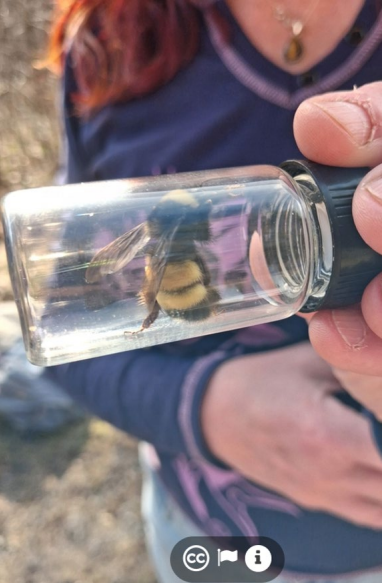
Yellow-banded bumble bee queen observed visiting willow in Torrington, CT, April 2026.
Protecting Agriculture, Public Health, and the Environment
An Affirmative Action/Equal Opportunity Employer