


PRESS RELEASE
FOR IMMEDIATE RELEASE
Monday, April 6, 2026
MEDIA CONTACT:
| Goudarz Molaei, PhD Research Scientist – Medical Entomologist Center for Vector Biology & Zoonotic Diseases The Connecticut Agricultural Experiment Station 123 Huntington Street New Haven, CT 06511 Phone: (203) 974-8487 |
Jason C. White, PhD Director The Connecticut Agricultural Experiment Station 123 Huntington Street New Haven, CT 06511 Phone: (203) 974-8440 |
New Haven, CT – The Tick Testing Program at the Connecticut Agricultural Experiment Station (CAES) is reporting an increasing number of blacklegged “deer” tick submissions to its testing laboratory, with a higher-than-average infection rate of Borrelia burgdorferi, the causative agent of Lyme disease.
According to Dr. Goudarz Molaei, who directs the CAES Tick Testing Program, “During the past few weeks, we have received an average of 30 tick submissions per day for testing, and greater than 40% have tested positive for Lyme disease spirochetes. In addition, these ticks have tested positive for the pathogens responsible for babesiosis, anaplasmosis, and Borrelia miyamotoi disease."
“We are at the beginning of the tick activity season for adult blacklegged ticks, which often have higher infection rates because they have had two chances to acquire disease agents during their juvenile stages (larva and nymph),” said Dr. Molaei.
“Using tick repellents when hiking or camping and conducting tick checks remain the best ways to reduce the risk of contracting tick-borne diseases,” said Dr. Jason White, Director of the CAES. “Connecticut residents are also encouraged to submit ticks they have removed from their bodies to our laboratory for species identification and testing. This allows them to make informed decisions concerning diagnosis and treatment in consultation with their healthcare providers,” added Dr. White.
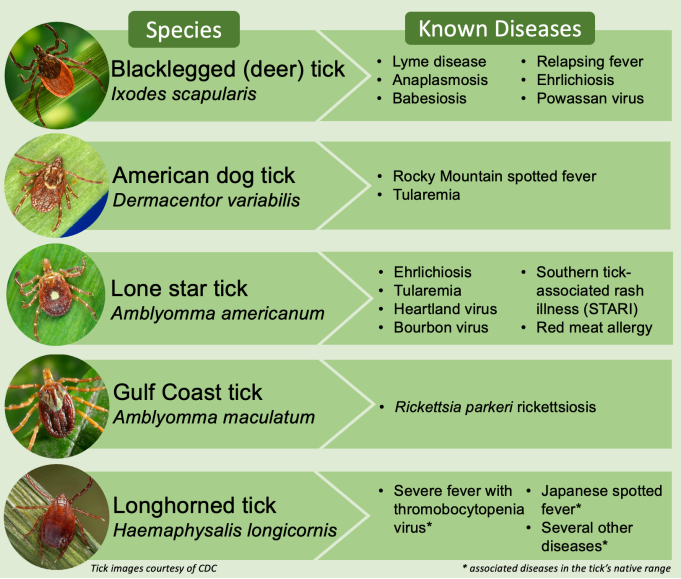
“In addition to pervasive populations of blacklegged and American dog ticks, Connecticut has established populations of three invasive species: the lone star tick, Gulf Coast tick, and longhorned tick, primarily in the coastal areas of Fairfield and New Haven counties,” said Dr. Molaei. “These ticks are capable of transmitting their own suite of pathogens responsible for ehrlichiosis, rickettsiosis, and Heartland virus, among others. The lone star tick can also induce Alpha-gal syndrome (a red meat allergy) that can lead to severe allergic reactions and even anaphylactic shock. The high populations of the longhorned tick in coastal areas of the two densely populated counties in the state are particularly concerning because this species reproduces without needing male ticks for egg fertilization, allowing it to spread rapidly.”
The CAES is investigating novel methods to manage tick populations. Additionally, the agency is researching the basic biology and ecology of ticks, tick-borne pathogens, barriers to prevention, and the prevalence of Alpha-gal syndrome in Connecticut residents, with the goal of improving public health and well-being.
According to the Centers for Disease Control and Prevention (CDC), Lyme disease is the most commonly reported vector-borne disease in the United States, affecting an estimated 475,000 people annually and causing potential damage to the joints and nervous system. The Connecticut Department of Public Health reported 2,170 cases of Lyme disease in 2024. While several hundred cases of babesiosis and human granulocytic anaplasmosis were also diagnosed, the actual number of disease cases could be nearly 10 times higher.
Detailed information about the Tick Testing Laboratory, personal protection measures, tick control measures, and tick-associated diseases can be found at the following websites:
- Tick Testing Laboratory
- Information on Submitting Ticks
- CDC Ticks
- CDC Lyme Disease
- CDC Anaplasmosis
- CDC Babesiosis
Protecting Agriculture, Public Health, and the Environment
An Affirmative Action/Equal Opportunity Employer