


PRESS RELEASE
FOR IMMEDIATE RELEASE
Thursday, March 26, 2026
MEDIA CONTACT
Dr. Hany K. M. Dweck, Chemical Ecologist
Department of Entomology
The Connecticut Agricultural Experiment Station
123 Huntington Street
New Haven, CT 06511
Phone: (203) 974-8531
E-mail: hany.dweck@ct.gov
New Haven, CT In a recent study published in the Proceedings of the National Academy of Sciences (PNAS), scientists at The Connecticut Agricultural Experiment Station (CAES) identified key cellular and molecular changes in the olfactory system of the spotted wing Drosophila (SWD, also known as Drosophila suzukii) that facilitated its shift from targeting overripe fruit to infesting fresh, ripe fruit. SWD was first detected in Connecticut in 2011 across 86 towns. Unlike most fruitflies, which have little or no impact on the fruit industry, SWD females possess a serrated ovipositor that allows them to lay eggs inside intact, ripening fruit. This enables maggots to develop in fruit that is still marketable. As a result, SWD causes substantial economic losses in soft fruit crops such as berries and cherries, costing U.S. growers hundreds of millions of dollars each year.
Current management strategies rely heavily on frequent insecticide applications. However, these treatments offer limited protection and can negatively affect beneficial insects, underscoring the need for more targeted and environmentally sustainable approaches. Motivated by this, CAES scientists set out to elucidate the unique olfactory adaptations and underlying mechanisms that allow SWD to exploit fresh, ripe fruit.
“Beyond addressing a fascinating biological question—how sensory systems evolve to allow an insect to break bad—this work is essential for developing new environmentally benign tools to reduce the damage caused by this pest,” said Jason C. White, Director of The Connecticut Agricultural Experiment Station.
“We screened every olfactory neuron in SWD and its relatives to identify the neurons that have changed specifically in SWD. We observed functional changes in a small subset of olfactory neurons, characterized by a loss of responses to several fermentation-related volatiles and a gain of sensitivity to fruit-ripening and green-leaf volatiles. This shift in sensory tuning may help explain the species’ shift in preference toward ripe fruit,” said Dr. Hany K. M. Dweck, lead contact of the study and head of the Chemical Ecology Laboratory in the Entomology Department.
“After identifying the olfactory neurons that differ in their odorant responses in SWD compared with its relatives, we used molecular genetics, protein modeling, and gene editing to uncover the mechanisms underlying these changes,” said Dr. Qi Xue, first author of the study and a postdoctoral scientist in the Chemical Ecology Laboratory. These differences arose through several innovative mechanisms. One example is an odorant receptor that expanded into four copies and became expressed in two neuron types: the ancestral neuron and a preexisting neuron that had lost its original odorant receptor. As a result, one of these neurons now responds to several fruit-ripening esters, while the second responds to green-leaf volatiles, instead of both responding to fermentation-associated volatiles. This innovation allows SWD to infest ripe fruit attached to a living plant rather than fermenting fruit that has fallen to the ground.
“To establish a causal link between these cellular and molecular changes and SWD’s preference for ripe fruit, we used CRISPR/Cas9 gene editing combined with behavioral assays and demonstrated that two of the odorant receptors expressed in these neurons are essential for locating fresh, ripe fruit,” said Dr. Qi Xue.
“This work also has practical applications,” said Dr. Hany Dweck. “Understanding the olfactory pathways involved in locating ripe fruit enables strategies similar to those used in drug discovery for treating diseases—such as chemoinformatics, artificial intelligence, and molecular docking—to screen millions of compounds and identify those that act on these pathways. These compounds can then be used to develop lures for monitoring and managing SWD populations.”
Journal Reference
Xue Q., Dweck H. K. M. (2026). Receptor sequence divergence, gain, loss, duplication, and neofunctionalization drive olfactory adaptation in Drosophila suzukii. Proceedings of the National Academy of Sciences: https://www.pnas.org/doi/10.1073/pnas.2529586123
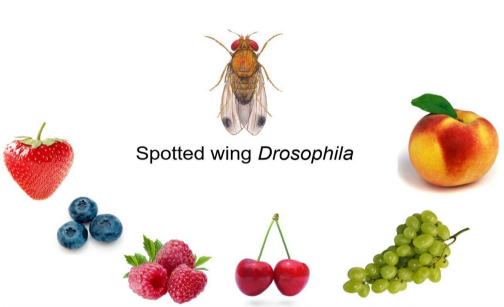
Figure Legend: Spotted Wing Drosophila and some of its host fruits
Protecting Agriculture, Public Health, and the Environment
An Affirmative Action/Equal Opportunity Employer