


PRESS RELEASE
FOR IMMEDIATE RELEASE
Monday, March 23, 2026
MEDIA CONTACTS:
Megan A. Linske, Ph.D. Megan.Linske@ct.gov
Douglas E. Brackney, Ph.D. Doug.Brackney@ct.gov
Jamie Cantoni Jamie.Cantoni@ct.gov
Duncan Cozens Duncan.Cozens@ct.gov
Department of Entomology
Center for Vector Biology and Zoonotic Diseases
The Connecticut Agricultural Experiment Station
123 Huntington Street
New Haven, CT 06511
Phone: (203) 974-8490
New Haven, CT – Researchers and staff from the Center for Vector Biology and Zoonotic Diseases at the Connecticut Agricultural Experiment Station (CAES) have released findings from the sixth year of the statewide active tick surveillance program. The 2025 results provide critical insights into tick populations and the prevalence of tick-borne pathogens across Connecticut.
More than 10,000 ticks were collected from 40 publicly accessible locations across all eight Connecticut counties during the spring, summer, and fall of 2025. These ticks were then tested for five human disease-causing pathogens: Anaplasma phagocytophilum (anaplasmosis), Babesia microti (babesiosis), Borrelia burgdorferi (Lyme disease), Borrelia miyamotoi (hard tick relapsing fever), and Powassan virus (Powassan encephalitis).
Key Findings:
- Blacklegged ticks, also known as “deer” ticks, (Ixodes scapularis, n = 3,459) remained consistently abundant across sampling efforts. Longhorned ticks (Haemaphysalis longicornis, n = 4,206), lone star ticks (Amblyomma americanum, n = 2,570), and American dog ticks (Dermacentor variabilis, n = 331) were also identified.
- While higher numbers of longhorned and lone star ticks were recorded this year, these totals were largely driven by isolated sampling events rather than widespread increases. Single sampling occasions accounted for large clusters of larval ticks at individual locations.
- New London County reported the highest average adult blacklegged tick density, with 81 per acre, and Litchfield County reported the highest average nymphal tick density, with 28 per acre.
- Pathogen testing indicated that Borrelia burgdorferi, the causative agent of Lyme disease, infection rates were highest in adult female ticks from Fairfield County at 68% and in nymphs from New Haven County at 32%.
Statewide Infection Rates in Blacklegged Ticks (Ixodes scapularis)
| Pathogen | Adults | Nymphs |
|---|---|---|
| Borrelia burgdorferi (Lyme disease) | 55% | 25% |
| Babesia microti (babesiosis) | 14% | 13% |
| Anaplasma phagocytophilum (anaplasmosis) | 9% | 5% |
| Borrelia miyamotoi (hard tick relapsing fever) | 2% | 2% |
| Powassan virus (Powassan encephalitis) | <1% | - |
“Ticks are still a common part of the Connecticut landscape, including both established and emerging species,” said Dr. Megan Linske, Vector Ecologist specializing in Tick-Host-Habitat Dynamics at CAES. “People can come into contact with ticks in their own yards or while enjoying the outdoors, so taking preventative measures is key to lowering the risk of tick-borne illness.”
To minimize exposure to ticks and reduce the risk of tick-borne diseases, residents are encouraged to:
- Conduct routine tick checks after outdoor activities.
- Wear long sleeves, pants, and light-colored, tightly woven clothing.
- Tuck pant legs into socks in tick-prone areas.
- Wear permethrin-treated clothing to repel and kill ticks.
For more information, visit https://portal.ct.gov/caes/tick-office/ats-tick-office/active-tick-surveillance-program/ct-atsp or contact Dr. Megan Linske at Megan.Linske@ct.gov.
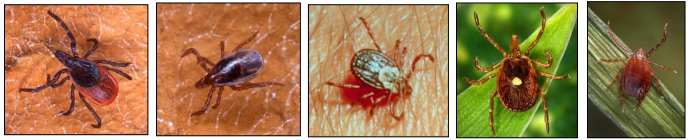
Left to right: I. scapularis female, I. scapularis nymph, D. variabilis female, A. americanum female, and H. longicornis female. Credits: USDA and CDC.
Protecting Agriculture, Public Health, and the Environment
An Affirmative Action/Equal Opportunity Employer